TPM Pillars
Total Productive Maintenance (TPM) is founded on eight fundamental pillars, each serving as a cornerstone for achieving operational excellence. These pillars are:
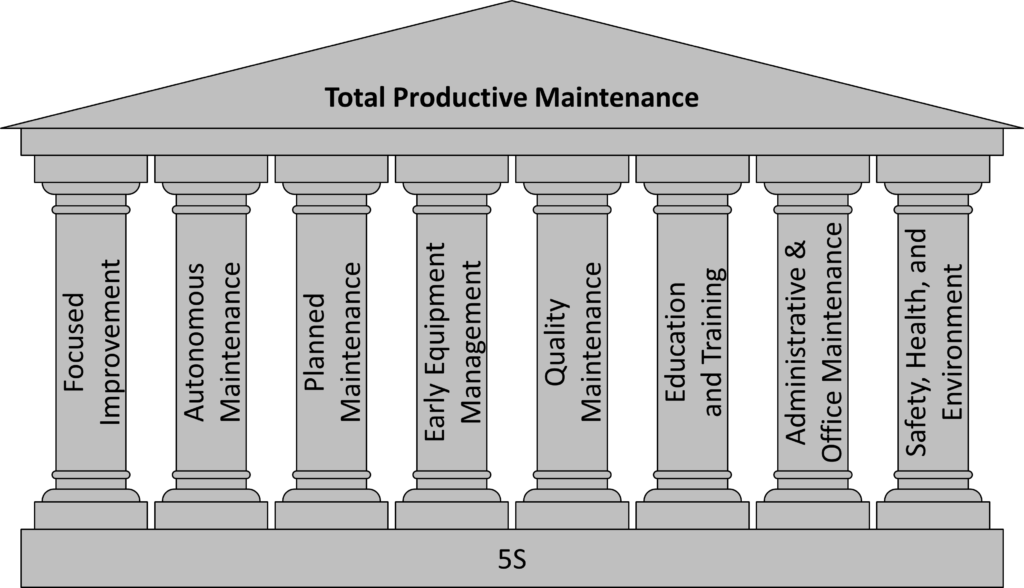
- Autonomous Maintenance (Jishu Hozen): Involves empowering operators to take responsibility for basic maintenance tasks, such as cleaning, lubricating, and inspecting equipment. This pillar aims to prevent breakdowns and equipment deterioration by fostering a sense of ownership and proactive maintenance among frontline workers.
- Planned Maintenance (Kanri Kaisei): Focuses on scheduling and executing maintenance activities based on equipment condition, usage, and performance data. Planned maintenance aims to minimize unplanned downtime, optimize equipment performance, and extend asset lifespan through systematic maintenance planning and execution.
- Focused Improvement (Kobetsu Kaizen): Encourages continuous improvement efforts to eliminate losses and inefficiencies in equipment, processes, and systems. Focused improvement activities involve identifying root causes of problems, implementing corrective actions, and driving incremental improvements to enhance overall productivity and performance.
- Early Equipment Management (Early Product Management): Involves optimizing equipment design, installation, and commissioning processes to ensure reliability, maintainability, and operability from the outset. Early equipment management aims to minimize defects, reduce startup times, and maximize equipment effectiveness throughout its lifecycle.
- Quality Maintenance (Hinshitsu Hozen): Focuses on preventing defects and ensuring product quality by maintaining equipment in optimal condition. Quality maintenance encompasses measures to address sources of variation, reduce process variability, and maintain equipment accuracy and precision to consistently meet quality standards.
- Education and Training (Kyōiku Koyō): Emphasizes providing employees with the knowledge, skills, and competencies required to perform their roles effectively and contribute to TPM initiatives. Education and training initiatives aim to enhance employee capabilities, promote safety awareness, and foster a culture of continuous learning and improvement.
- Administrative and Office TPM (Shitsuke Katsuyō): Extends TPM principles and practices beyond the shop floor to administrative and office environments. This pillar focuses on optimizing administrative processes, reducing paperwork, and improving communication and collaboration to support overall operational excellence.
- Safety, Health, and Environment (Anzen Kankyō Seisaku): Prioritizes the safety, health, and well-being of employees, customers, and the environment. This pillar aims to create a safe and healthy workplace by identifying and mitigating safety hazards, promoting ergonomic design, and ensuring compliance with environmental regulations and standards.
These eight TPM pillars collectively form the foundation for building a culture of excellence, continuous improvement, and operational efficiency within an organization.

Reading your work felt like discovering a new language — one that speaks directly to the heart while still offering intellectual depth.